
 By Allen Khudaverdyan
Peer Reviewed
For over a century, 98.6° Fahrenheit (37° Celsius) has been etched into our collective consciousness as the “normal” human body temperature. From routine check-ups to COVID-19 screenings, this number has served as a critical diagnostic threshold. But where did it come from, and is it still valid? Emerging evidence suggests that this widely accepted standard may be outdated, with important implications for clinical care and public health.
The Origins of 98.6°F
The number originates from a study by German physician Carl Wunderlich in the 19th century. Using a mercury thermometer, he recorded axillary temperatures of over 25,000 patients and concluded that the average body temperature was 37°C (98.6°F). However, modern scrutiny reveals several limitations: Wunderlich used less accurate instruments, measured axillary rather than core temperatures, and didn’t account for circadian or individual variation.1
The Data Tell a Cooler Story
In recent decades, multiple studies have challenged the 98.6°F benchmark. A 1992 study published in JAMA analyzed over 700 healthy adults and found an average oral temperature closer to 98.2°F, with a standard deviation suggesting a broader “normal” range.1 More provocatively, a 2020 longitudinal analysis published in eLife showed a decline in average body temperature in the U.S. population over the past two centuries, now closer to 97.5°F.2
This drop could be attributed to reduced chronic infections, lower basal metabolic rates, and widespread use of climate control and anti-inflammatory medications. Regardless of the cause, the data suggest that our baseline has shifted—and perhaps our diagnostic thresholds should too.
Variability Matters
Body temperature is not a fixed number. It varies by time of day (lowest in the early morning, highest in the late afternoon), menstrual cycle, age, and method of measurement. Oral temperatures are typically lower than rectal and tympanic readings. Furthermore, elderly patients often have a blunted febrile response, meaning a fever in this population might manifest as a mere 99°F—a value that many clinicians might mistakenly interpret as normal.3
Clinical Implications
Relying rigidly on 98.6°F can lead to missed diagnoses. During the COVID-19 pandemic, fever thresholds were used to screen patients for infection. But if a person’s baseline temperature is 97.0°F, then a reading of 99.0°F may represent a meaningful rise. Similarly, in sepsis screening, missing a low-grade fever could delay recognition and treatment.4
Some experts have proposed a more personalized baseline temperature for patients, particularly those in high-risk populations like the elderly, immunocompromised, or chronically ill. Incorporating serial measurements and accounting for individual variability could improve diagnostic accuracy.5
Rethinking “Normal”
So what is normal? Most modern sources cite a range between 97.0°F and 99.0°F, acknowledging variation. But even this range may not be sufficient for all patients. As we move toward more personalized medicine, it may be time to move beyond static thresholds and embrace dynamic baselines.
Medical education often teaches precision: a fever is 100.4°F, hypothermia is below 95°F, and 98.6°F is normal. But in practice, physiology is more fluid. Recognizing this nuance is essential for improving diagnosis and patient care.
Final Thoughts
The myth of 98.6°F is a reminder that even the most accepted medical “facts” deserve reexamination in light of new evidence. As physicians, we must be willing to question dogma, integrate emerging research, and tailor our assessments to the individual. The next time you see a temperature of 99°F, think twice before calling it “normal.”
Allen Khudaverdyan is a class of 2027 medical student at NYU Grossman School of Medicine
Reviewed by Michael Tanner, MD, Executive Editor, Clinical Correlations
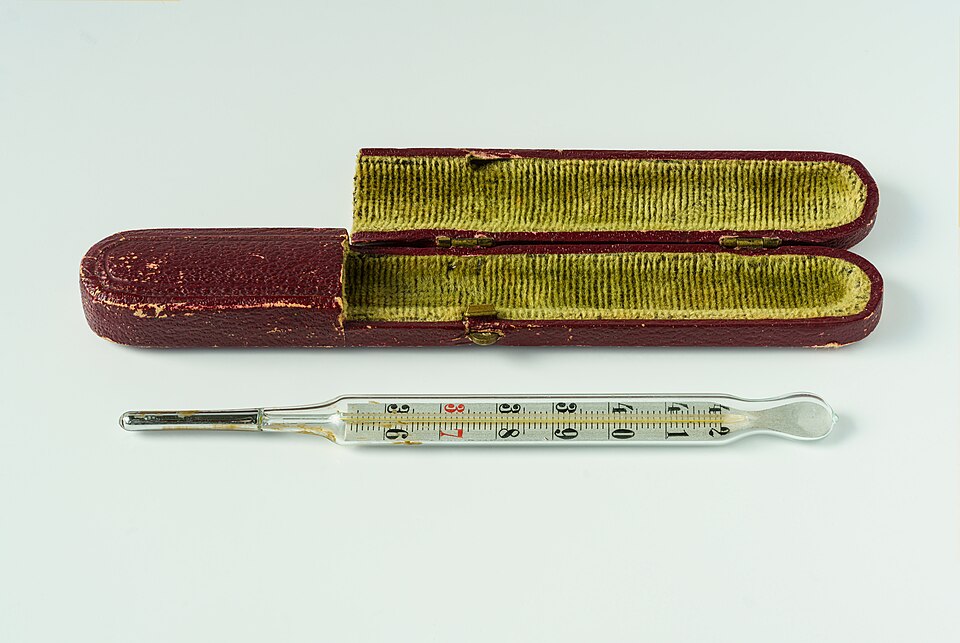
Image courtesy of Franz van Duns, CC BY-SA 4.0 <https://creativecommons.org/licenses/by-sa/4.0>, via Wikimedia Commons
References
- Mackowiak PA, Wasserman SS, Levine MM. A critical appraisal of 98.6°F, the upper limit of the normal body temperature, and other legacies of Carl Reinhold August Wunderlich. JAMA. 1992;268(12):1578-1580. https://jamanetwork.com/journals/jama/fullarticle/400116.
- Protsiv M, Ley C, Lankester J, Hastie T, Parsonnet J. Decreasing human body temperature in the United States since the industrial revolution. eLife. 2020;9:e49555. https://elifesciences.org/articles/49555.
- Gomolin IH, Aung MM, Wolf-Klein G, Auerbach C. Older is colder: temperature range and variation in older people. J Am Geriatr Soc. 2005;53(12):2170-2172. https://agsjournals.onlinelibrary.wiley.com/doi/10.1111/j.1532-5415.2005.00500.x.
- Singer M, Deutschman CS, Seymour CW, et al. The Third International Consensus Definitions for Sepsis and Septic Shock (Sepsis-3). JAMA. 2016;315(8):801-810. https://jamanetwork.com/journals/jama/fullarticle/2492881.
- Obermeyer Z, Samra JK, Mullainathan S. Individual differences in normal body temperature: longitudinal big data analysis of patient records. BMJ. 2017;359:j5468. https://www.bmj.com/content/359/bmj.j5468